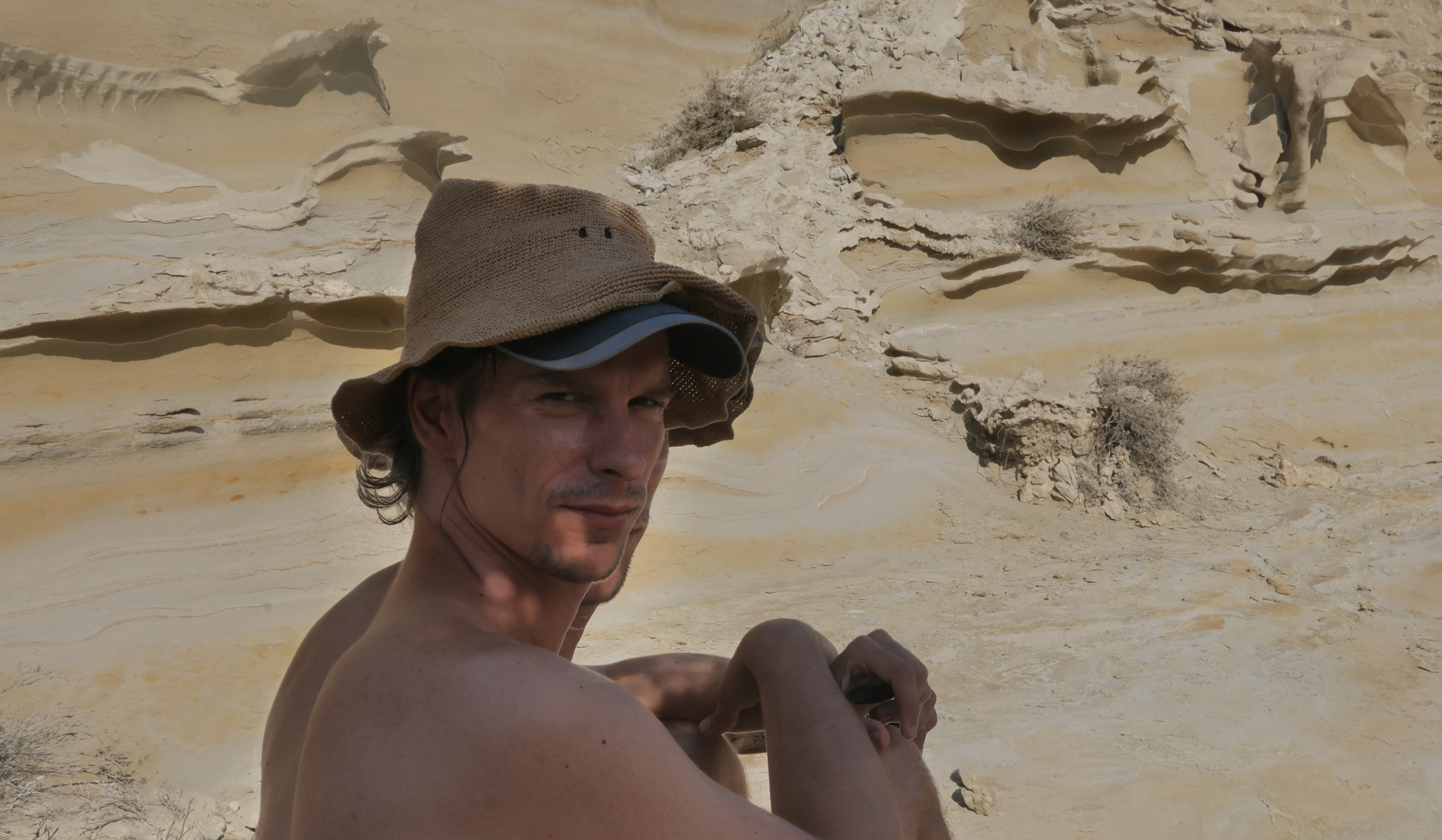
The Stanley Maneuver is the solo project of András Molnár, a musician, DJ and organiser based in Budapest. His practice focuses on weaving a web of fragile environments that possess their own histories, desires, faults and secrets. Building upon improvisational and generative techniques, he continually repurposes his materials to explore territories in and around experimental music and intimacy. In addition to his solo work, he collaborates extensively with multidisciplinary artists and contemporary dancers on performances, installations and experimental computer simulations.
Can you tell us what lies behind the name “The Stanley Maneuver”, and what your background is? How did you start making music?
My father had a brief career as a DJ in the 70s and 80s, and as a result we had many records lying around at home—something was always playing in the background. I was also fortunate enough to grow up in the 90s, when music videos and MTV were still a thing, and my sister and I would start each morning glued to the TV, waiting for our favourite new songs to come on. Looking back, I’m grateful that I had to sit through a lot of music that I didn’t like at the time or still don’t like today. That just never happens anymore. It was more or less the antithesis of the echo chamber of today’s media.
I started making music very spontaneously around 2006, after training in piano. For the first few years I was mostly learning by copying my favorites, and then it evolved from there. The name The Stanley Maneuver is a reference to Harold Pinter and to a fictional scientific phenomenon.
Your roles in the world of music are diverse: from curating events to DJing and producing, and now also running a label. Can you talk about how these roles come together, how they complement each other, whether there are any complications that arise from their overlap, and which one you’re focusing on at the moment?
I used to spend most of my time satisfying my curiosity by discovering new music and then kept trying to find new ways to share those gems with anyone who cared. I only started DJing because I felt that a lot of the music I was listening to was underrepresented on the dancefloors of Budapest. That’s also how I ended up getting involved in music journalism and organising events. Building platforms for like-minded people to meet each other around moments in music is a responsibility I’ve always felt drawn to.
This curiosity also led me to making my own music, which for me is a whole other kind of position. It can be very hard to do these two things at the same time for various reasons, and most of the complications happen at the intersection of these two roles. More often than not, I’ve prioritised introducing artists to listeners—and vice versa—over creating my own work. It’s pure logic: at best, I can be one great musician, whereas there have been millions of great musicians throughout history, many still undiscovered. If you think about it, it’s not even close which focus benefits the world more. The problem is that I can’t stop making music, so there’s that.
Can you talk about your musical and performance work? You use turntables and other instruments, and this is perhaps where your DJ work also comes into play. How do you create and perform your music?
I’ve used turntables and CDJs as instruments in a live setting before, but I mostly work with Ableton, a healthy rotation of DIY instruments, a Space Echo (a unit that once belonged to the legendary Hungarian songwriter and musician Gábor Presszer—which is pretty random) and, more recently, a sixty-year-old Eastern European electric piano that you might hear on a Joe Meek record. I like things messy and unpredictable, and that also influences my choice of instruments.
When I create or perform my music, I just try to be present and remain very attentive. I fall in love most easily with themes that feel very simple yet mysterious at the same time. Improvisation, recycling of my own materials, found sounds and chance-based instruments are all huge parts of how I work.
You’re also involved in the contemporary dance scene in Budapest, collaborating with several performance groups in the city. Can you talk about your work in this field?
Through some collaborations earlier in my career, I got close to a then-emerging generation of dancers and choreographers, which led to projects with the artist group Hollow, Szeri Viktor and Vavra Júlia, among others. I was fascinated by this entire generation’s work even before meeting them because I feel that they managed to break down quite a few walls while never losing sight of their own individual paths. When I work in such a context, my music becomes an extension of someone else’s work, a symbiotic relationship takes shape, and a new language is born. I find this process deeply rewarding for my own practice as well.
You are setting up a new label – Folyékony Máshol. Can you talk about the label and its concept?
I spent a few years curating festival lineups and managing clubs before deciding to go back to doing things the DIY way. That’s when Folyékony Máshol (which translates as Liquid Elsewhere btw) started out, initially as an event series. The idea was to erase the divide between “serious”, adventurous concert/live-act lineups and dance-music-focused lineups, making the events more unpredictable and playful, while also bringing other mediums like fine art, installation and performance art into the mix.
The concept of the label is very simple as well. First, I consider myself an independent artist, and while I’d love to release music elsewhere, doing things in a self-released way holds a strong romantic appeal for me. Second, I’m surrounded by a lot of super talented friends who seem to be waiting for the right opportunity, a helpful push to get more of their music out there. That need also led me to envision Folyékony Máshol as a label. The music will probably always lean toward the experimental, but the styles will be varied, with artists such as Alley Catss, Ateuqram and ooo set to release music in the near future.
You are releasing a new album entitled Ageless Mist. Can you talk about it?
The first release on Folyékony Máshol will be Ageless Mist, a project I completed about four years ago that eventually became the first part of a trilogy. I started working on this material when I was preparing for a show at UH Fest. It’s about the era before history—before even the universe was born—and about the peaceful social life of higher intelligences living in that ageless mist. Stillness, oneness, playing with the spatial element of sound, and a kind of a medieval sci-fi tone are all central themes. Conceptualising utopias has always fascinated me, and I find the idea of going that far back in order to start over pretty entertaining.
I’ve already finished the second part of the trilogy, entitled Goblintown’s Absolution, which is a concert performance involving two contemporary dancers. It uses a folk-tale format to tell the story of how the higher intelligences of the Ageless Mist came down to Earth to bestow upon us an enchanted, hi–tech invention—Népsziget’s Fin, an instrument I designed for the project—that shoots niceness and transforms everything in an instant, restoring the utopia of the Ageless Mist.
Interview Lucia Udvardyova